ALLIUM LONGISPATHUM
Family and Genus:- See- ALLIACEAE/Sect. CODONOPRASUM
Common Name:- None
Homotypic Synonyms:- Allium paniculatum subsp. longispathum,Allium
paniculatum var. longispathum,vAllium paniculatum f. longispathum,
Codonoprasum longispathum.
Meaning:- Allium (L) The ancient Latin name for garlic.
Longispathum (L) With long spathes.
General description:- Short to medium, bulbous perennial, smelling strongly of
onion or garlic when crushed.
Bulb:-
1) Narrowly ovoid, 1-2·5 cm in diam;
a) outer tunics, membranous, usually brown.
Stem:-
1) 20-60 cm, slender.
Leaves:-
1) 3-5, sheathing the stem up to halfway, linear, canaliculate above, prominently
ribbed beneath, usually glabrous.
Flowers:-
1) Campanulate, usually brownish or tawny pink;
a) perianth segments 4-6 mm, usually obtuse.
2) Umbel, 3·5-7 cm in diam, diffuse, hemispherical to ovoid, usually many-flowered,
without bulbils.
a) pedicels, 10-70 mm, very unequal, the outer curving outwards, the inner erect.
3) Spathe 2-valved; valves unequal, ovate to narrowly lanceolate at the base,
contracted above into a long appendage, the longer valve 5-14 cm, greatly
exceeding the pedicels.
4) Stamens, included or slightly exserted.
a) filaments c. 5 mm, connate at the base into an annulus c. 1·5 mm high,
sometimes with a small tooth in the sinus.
5) Anthers, yellow, slightly exserted.
6) Ovary, ellipsoid, twice as long as broad.
a) style, 1-2 mm, slightly exserted.
Fruit:-
1) Capsule c. 5 mm
Key features:-
1) Perianth segments 4-6 mm, usually obtuse.
2) Ovary elipsoid, scarcely papillose .
Habitat:- Garigue, open woodland, dry meadows, sometimes in fallow fields,
vineyards and other disturbed habitats, 01200 m.
Distribution:- S Europe and eastwards through Anatolia to Iran. Greece.
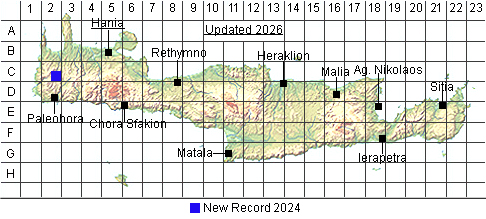
Previous unrecorded from Crete. Discovered by Christopher Cheiladakis July 2024
near to Stovies, in the west.
Flowering time:- May-August, sometimes later.
Photos by:- Christopher Cheiladakis
SPECIES DESCRIPTION